Fixed-tripod night sky
Milky Way exposure, measured in pixels
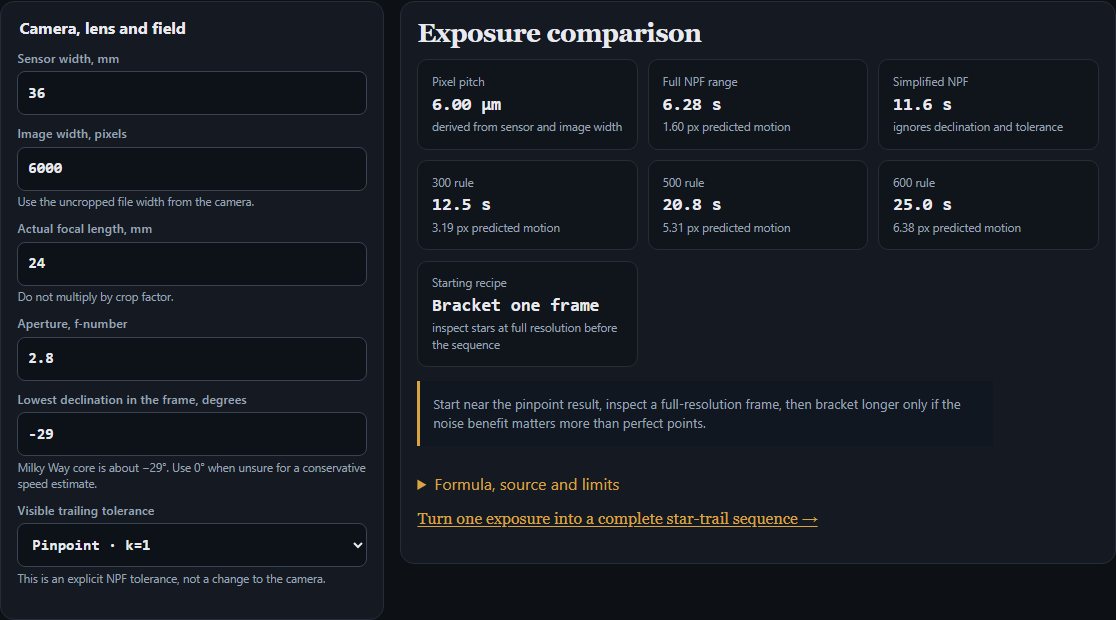
Compare the full NPF calculation with the old 300, 500 and 600 rules. The result shows what each shutter time means on your sensor instead of presenting one magic number.
Exposure comparison
Calculating…
Formula, source and limits
The full and simplified NPF formulae are credited to Frédéric Michaud and the Société Astronomique du Havre. Read the author’s formula and conditions. The formula is used with credit under the author’s stated conditions; commercial reuse requires the author’s permission.
The full result uses k × (16.9N + 0.10f + 13.7p) / (f cos δ). The movement readout independently projects the sidereal rate through focal length and pixel pitch. Seeing, focus, aberrations, resampling and where the frame is inspected can dominate sub-pixel differences, so the result is a starting range, not a guarantee.