Comet stacking, where every scientific decision is yours
A comet moves against the stars, so one set of frames holds two subjects that cannot both be sharp — and this mode builds both stacks plus a composite from the same Lights, with every scientific decision supplied by you rather than guessed: the nucleus in each frame, which frames count for each product, and which reference each is measured against.
On this page
Watch it happen: the video guide for this mode (4:07) shows five frames, every nucleus marked by hand, and the three results with the receipt that names the reference, on the real application with every count as it reported it.

.jpg)
Two subjects in one set of frames
Over an hour a comet moves against the background stars. Align on the stars and the comet is a smear; align on the comet and every star is a short trail. There is no third alignment that fixes both, because the two subjects genuinely were in different places relative to each other in every exposure.
So this mode makes both, from the same Lights: a star stack registered on the field, a comet stack registered on the nucleus you marked, and a composite that takes the sharp part of each. Seeing all three is the point — the composite is a choice, and a choice is easier to make when you can see what it was made from.
What you supply, frame by frame
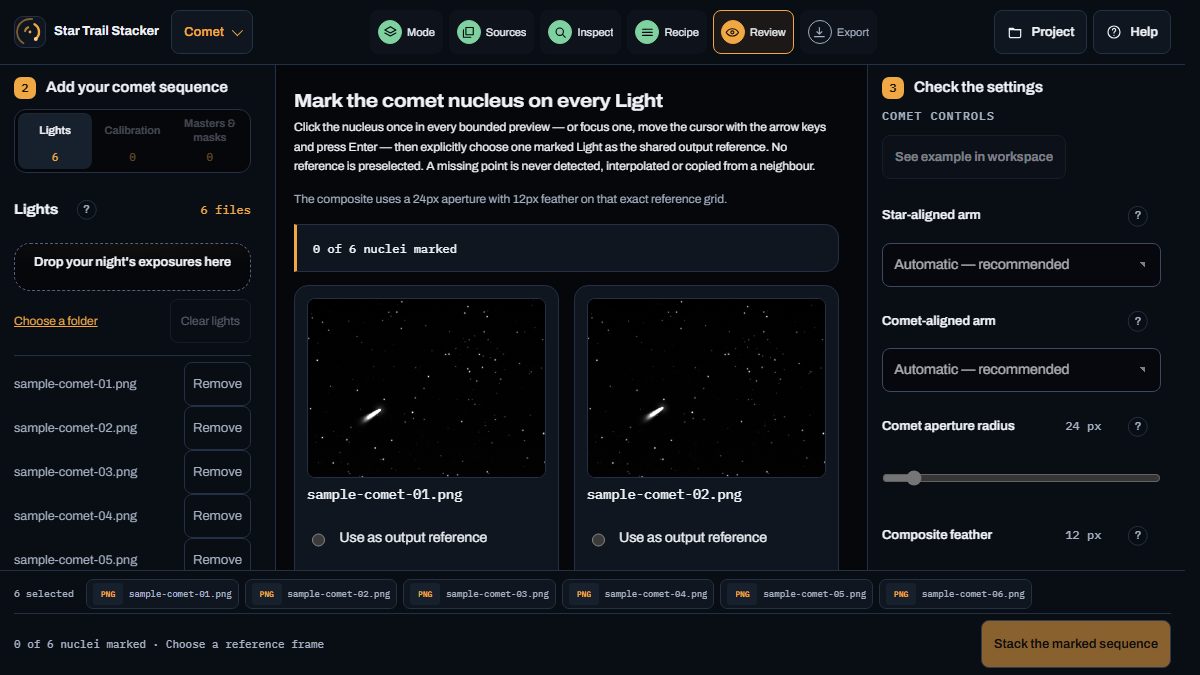
- The nucleus in every frame. Not in one and interpolated — in every frame that counts, so the comet registration is measured rather than modelled.
- Two inclusion ledgers. A frame good enough for the star stack is not automatically good enough for the comet stack and the reverse is just as true, so each product keeps its own list.
- Two references. One frame the field is measured against, one the nucleus is.
- A compositing mask, optionally. Absent, you get the two stacks and no composite rather than a composite made along a boundary nobody drew.
What it refuses to guess, stated as a rule
This module does not detect, does not register on its own, does not choose frames, does not invent a mask, and never substitutes a fallback. That list is the contract, not an apology for missing features: an automatic nucleus finder that is right most of the time produces a comet stack that is subtly wrong some of the time, and nothing in the finished picture says which time this was.
It is more work than a button. It is also the only version of this where you can say what the picture is a picture of.
Automatic for each arm, and the same eight-frame floor
Each arm starts on Automatic. With eight or more Lights it uses the two-pass clipped mean: every Light is read and registered twice, the first pass measures each pixel's mean and spread, and the second averages only the samples close to it. In the star-aligned arm that leaves out hot pixels, cosmic rays and satellites. In the comet-aligned arm it leaves out the stars themselves, which trail across each pixel in only a few Lights. Its memory does not grow with the number of Lights.
With fewer than eight Lights, or when the clip would not fit your device's memory and a mean would, Automatic uses Mean for that arm instead of refusing, and the result says which each arm used and why. It is a rule about the method, stated in the result, not a guess about your frames.
Choosing a method yourself always overrides it: Mean, exact median, the sigma-clipped mean or the two-pass clipped mean, the same ones the deep-sky mode offers. A clip you choose carries the same refusal below eight frames for the same reason: a spread estimated from five samples then used to discard one of them produces a cleaner-looking picture by removing information. The longer version of that argument is on the deep-sky page.
Try it on your own night
Open Comet in the stacker Nothing is uploaded and nothing is installed; the frames are read in your browser.