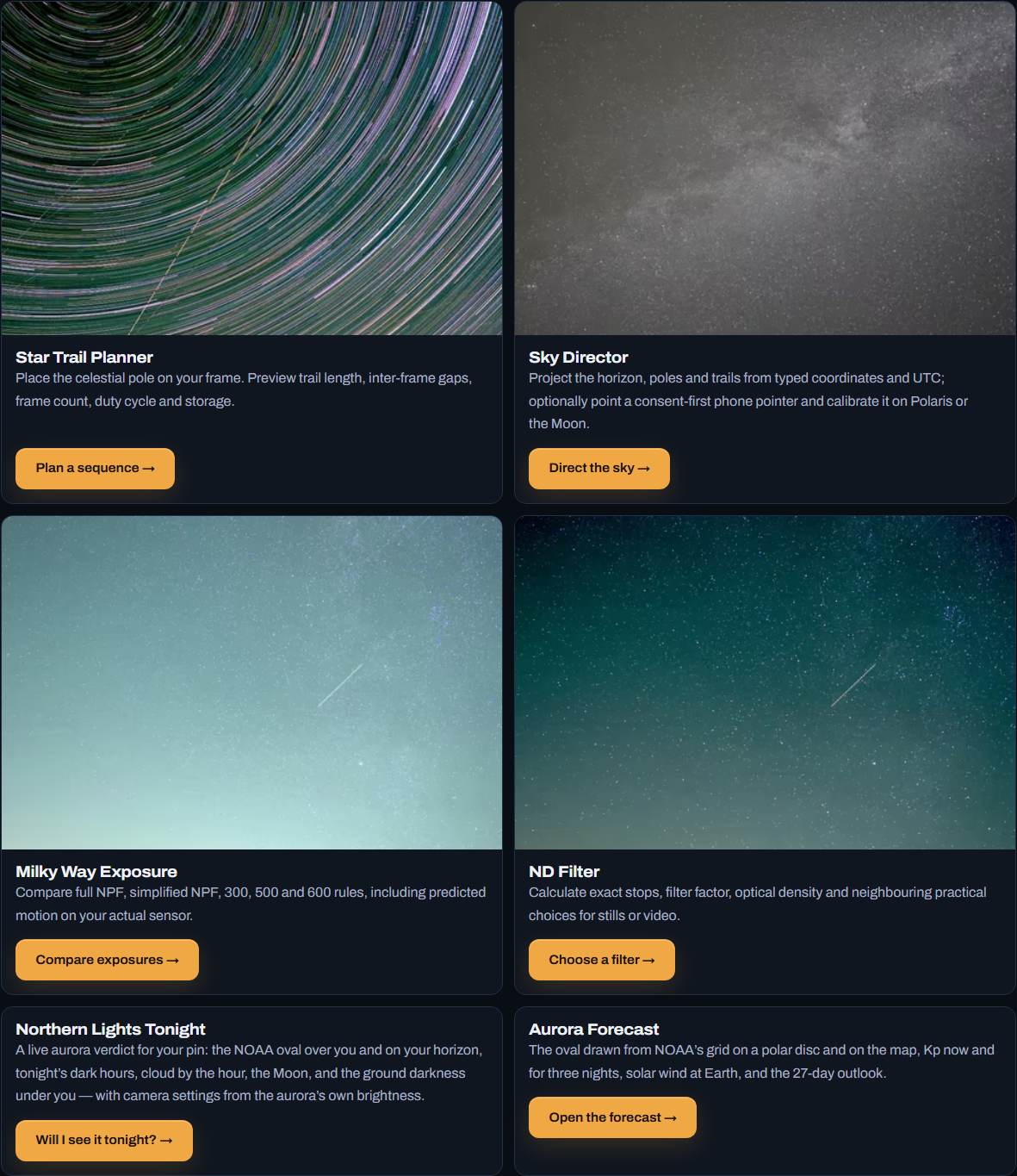
Star Trail Planner
Place the celestial pole on your frame. Preview trail length, inter-frame gaps, frame count, duty cycle and storage.
Plan a sequence →The calculators work in this tab and keep shareable inputs in the URL fragment; Sky Director keeps precise location only in memory and shows the limits behind its manual projection.
Place the celestial pole on your frame. Preview trail length, inter-frame gaps, frame count, duty cycle and storage.
Plan a sequence →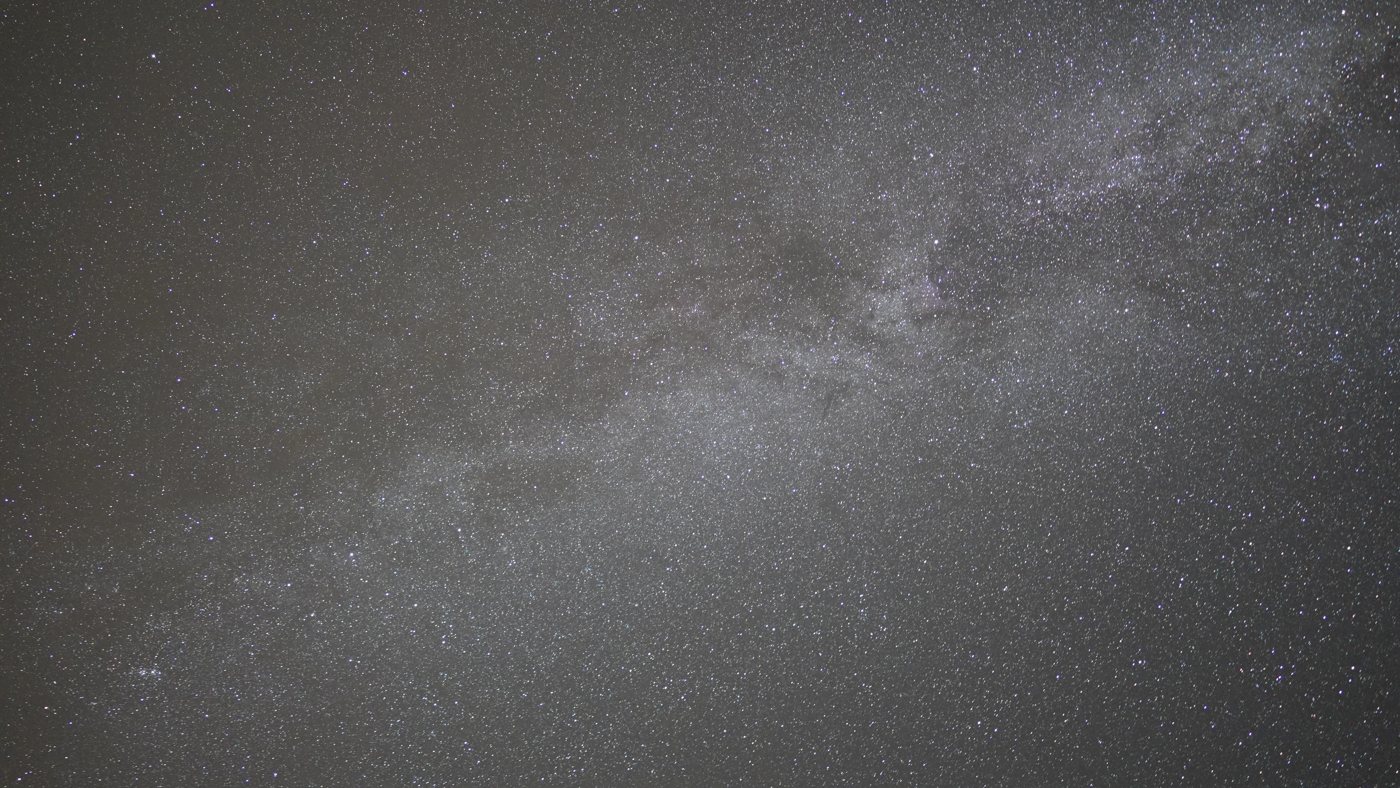
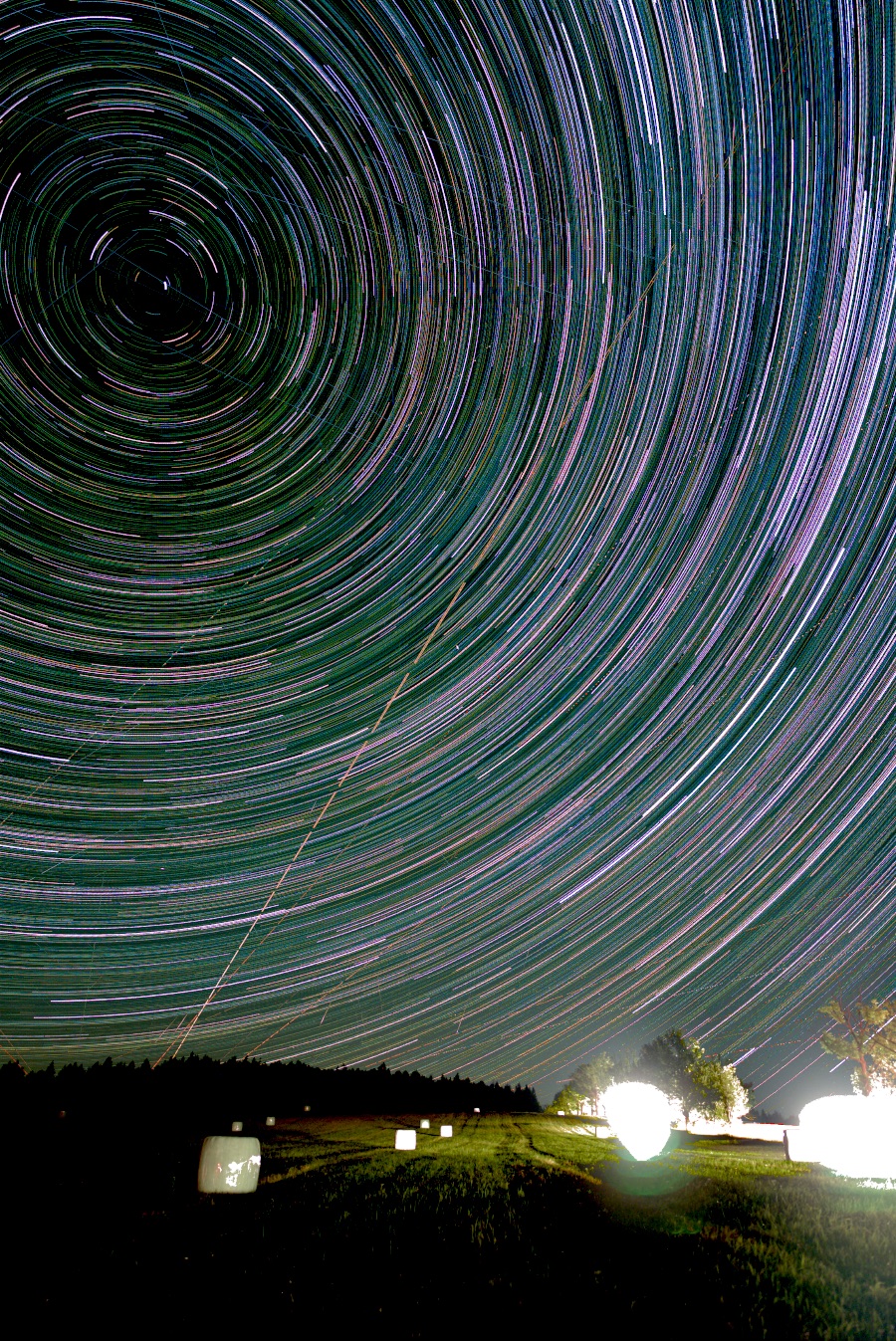
Project the horizon, poles and trails from typed coordinates and UTC; optionally point a consent-first phone pointer and calibrate it on Polaris or the Moon.
Direct the sky →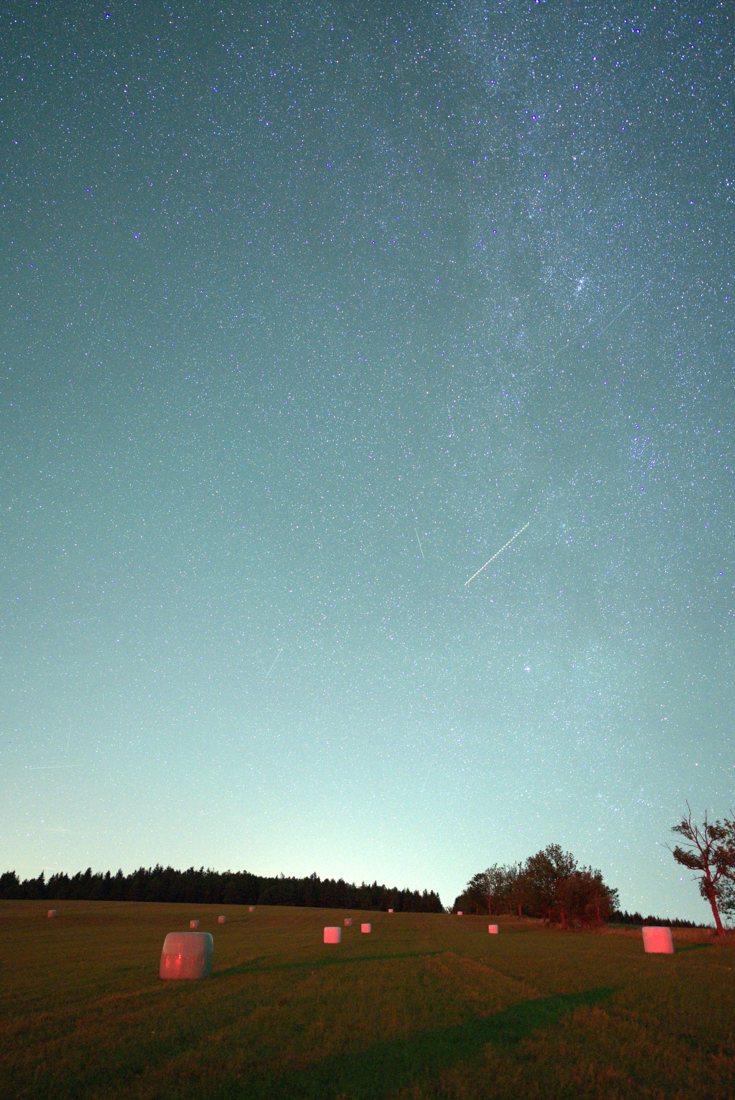
Compare full NPF, simplified NPF, 300, 500 and 600 rules, including predicted motion on your actual sensor.
Compare exposures →
Calculate exact stops, filter factor, optical density and neighbouring practical choices for stills or video.
Choose a filter →A live aurora verdict for your pin: the NOAA oval over you and on your horizon, tonight’s dark hours, cloud by the hour, the Moon, and the ground darkness under you — with camera settings from the aurora’s own brightness.
Will I see it tonight? →The oval drawn from NOAA’s grid on a polar disc and on the map, Kp now and for three nights, solar wind at Earth, and the 27-day outlook.
Open the forecast →Sky Director reports low-precision Sun and Moon direction, Moon illumination and phase; civil, nautical and astronomical UTC twilight. Its optional phone pointer reads motion sensors, and a compass where the phone has one, only after you enable it; it never opens the camera or requests your position, and it states its confidence. The orientation module loads only after an explicit control. Low-precision directions exclude terrain and atmospheric refraction.
The trail planner answers where arcs land and how a sequence fits. Sky Director projects declared geometry and reports Sun/Moon direction, Moon illumination/phase and three UTC twilight levels, while still making no star-catalogue, terrain or refraction claim and labelling its phone pointer as an estimate. The Milky Way calculator compares shutter rules in sensor pixels, while the ND calculator converts one metered exposure into filter choices.