What a star-trail stacker should do, and most miss
A plain lighten stack keeps the brightest value at every pixel; this tool also compares neighbouring Lights and removes measured moving lines before stacking, equalises the sky in each frame, names the frame behind any pixel, exports signed FITS, and runs entirely in the browser. Here is what that means on a real night — where an aircraft crosses the frame, a satellite draws a line through your stars, and the sky brightens toward the horizon — set against what a plain lighten stack does instead. No product is named; the comparison is against the approach the category runs on.
On this page
Where a plain stack stops, and this tool keeps going
| On a real night… | A plain lighten stack | This tool |
|---|---|---|
| An aircraft or satellite crosses a frame | Keeps the bright track — it is the maximum — so the line ends up in your picture. | Compares neighbouring Lights before stacking, then verifies and repairs the line at full resolution. It reports every decision and never guesses whether a line is an aircraft, satellite or meteor. How → |
| The sky brightens through the night | The brightest background sets the floor, and your faintest trails sink under it. | Equalises each frame’s sky before blending, so a faint trail survives a sky that drifts with light pollution or the rising Moon. Why → |
| The camera pauses between exposures | Leaves a dashed trail — the gaps are simply missing. | Fills the dashes along the arc the stars travel, using your own frames’ timing rather than a guess. Why dotted → |
| You ask “where did that come from?” | Cannot say. The stack forgets which frame won each pixel. | Names the frame behind any pixel — click the finished picture and it tells you which exposure made that point. |
| You want the real numbers, not a picture | Hands back a JPEG or PNG and asks you to trust it. | Exports signed, unclamped 32-bit FITS alongside the picture for deep-sky, comet and planetary — the measured values, not a display stretch. |
| You shot more than star trails | Does one thing. | Six modes in one place: star trails, fixed-ground nightscapes, registered deep-sky, comet, planetary lucky-imaging and RAW calibration masters. |
| Where your photographs go | Often uploaded to a server to be processed. | Nothing is uploaded. Every frame is read and stacked in this browser tab — on Windows, Linux or a Mac, with no installation. |
| How you know any of this is true | You don’t; the number is asserted. | Every figure is measured and shown, with the method and the limits, on frames the tool never trained on. |
The part everyone gets wrong: aircraft and satellites
This is the difference that matters most, and it is getting worse every month. A bright satellite train or an aircraft’s strobing trail is, by definition, the maximum at those pixels — so a lighten stack keeps it. Removing it by throwing away the brightest samples (sigma rejection) takes your meteors with it, because a meteor is also a one-frame bright streak.
This tool does neither. A matched filter integrates along candidate lines so a track far too faint to see in any single pixel adds up to a detection, and a small learned network trained on thousands of hand-labelled frames suggests additional places to inspect. A historical, frame-held-out test from one Sony A7C night found higher raw tile precision than the compared detector at matched recall. Training included other frames from that night; this is not an independent camera or night test. Its proposals are now checked against neighbouring Lights before the stack, and the original full-resolution pixels must confirm the line before a mask is applied. An unmasked exposure can supply the stack maximum; later arc gap repair can bridge some remaining holes. Every number is raw detector output, and no line is given an object class the pixels cannot prove.
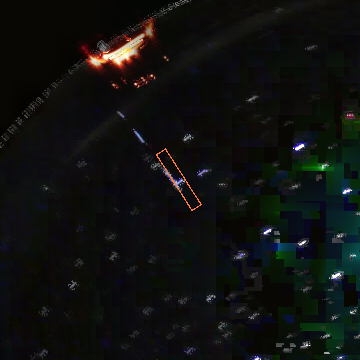
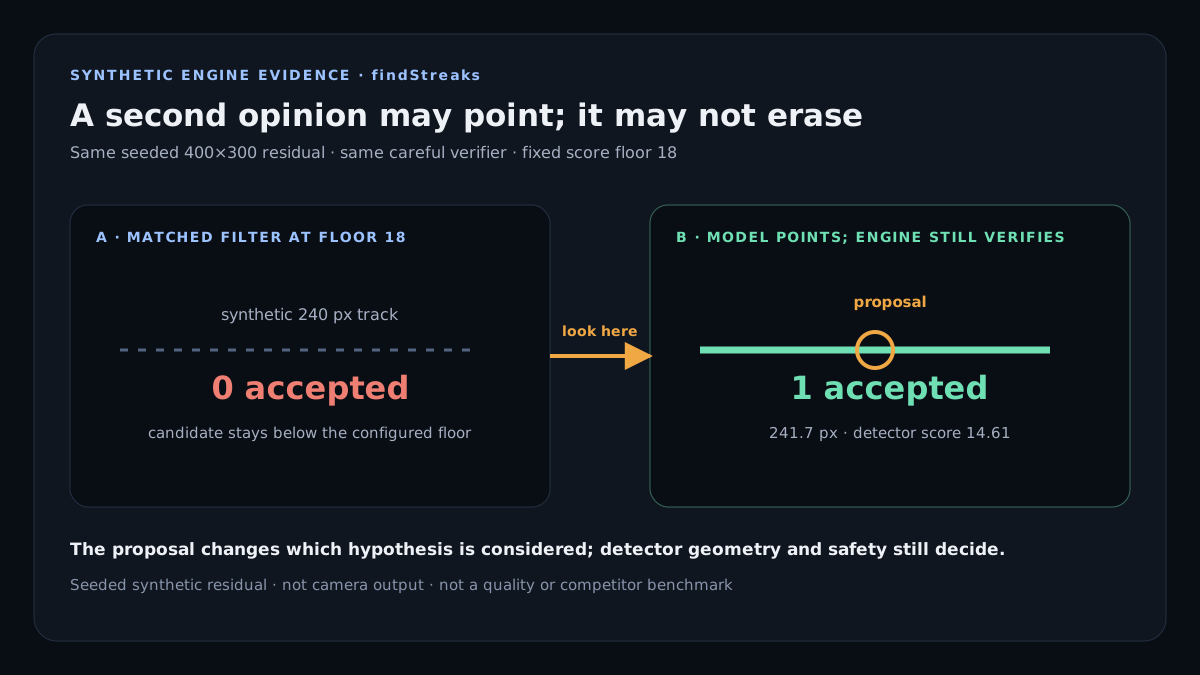
findStreaks evidence: the proposal changes where the tested engine looks, not its verification rules. It is not camera output or a competitive benchmark.