Long exposure and motion
Choose the ND filter, not just the stop count
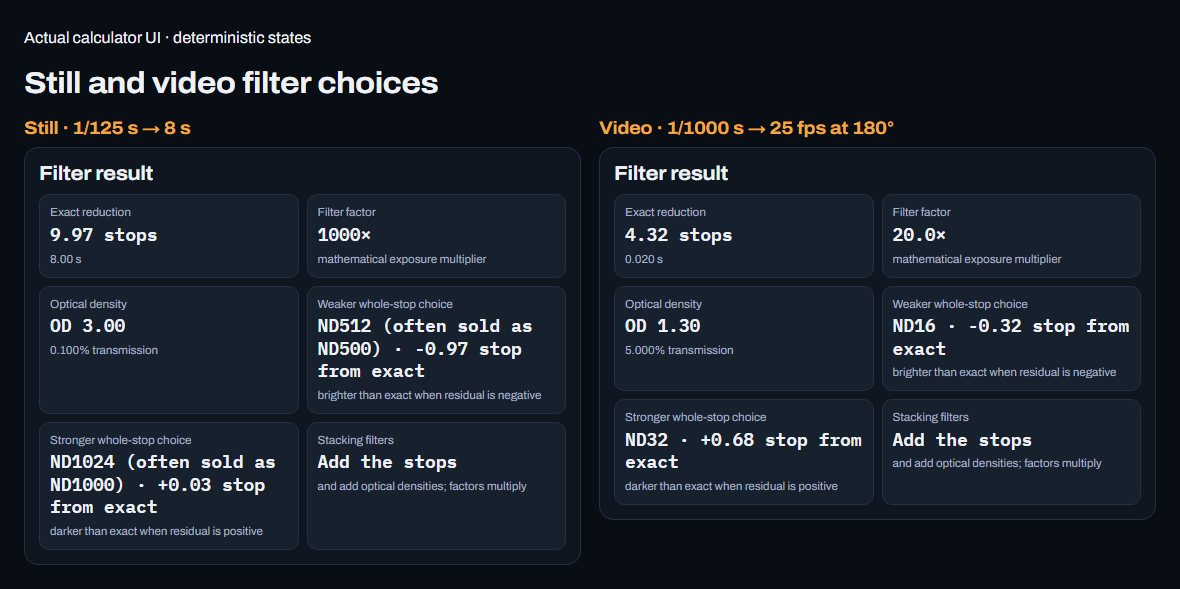
Start from the shutter reading without a filter. Get the exact reduction, both neighbouring real filters, and the exposure difference each choice leaves behind.
Filter result
Calculating…
Formula and practical limits
stops = log₂(target time / unfiltered time). The factor is 2^stops; optical density is log₁₀(factor). One stop is therefore OD 0.301, commonly labelled 0.3. NiSi’s published conversion table shows the same stop/factor/density relationship.
Real filter labels round ND512 to ND500 and ND1024 to ND1000. Strong filters can shift colour, and variable ND filters can show an X-pattern near their limit. Meter and make a test frame after fitting the real glass.