Video guides

Seven videos: one whole night from folder to finished file, then one for each of the six modes. The written guides explain one thing at a time; the videos show the whole thing happening: a real night, the real application, every count and elapsed time exactly as the tool reported it. Long waits are cut, never sped up, and a miss stays on screen as a miss.

A full night in Star Trail Stacker

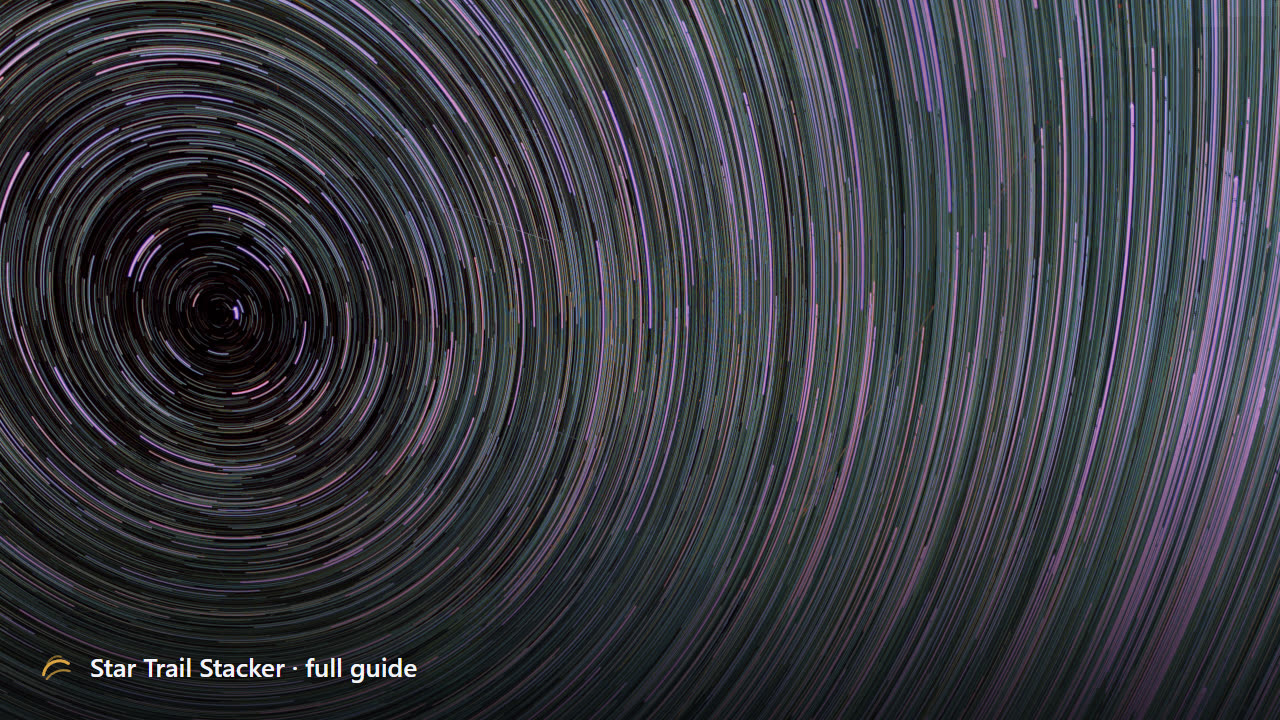
The finished 380-frame star trail from the guide: concentric arcs about the pole 4:38 Video guide · 4:38 · YouTube, privacy-enhanced player 380 Sony A7C RAW frames, from folder to finished 16-bit export Loading and inspecting the Lights, the recipe, Resource plan, the real Prepare → Survey → Build run, the receipt, Review with one overruled decision, the restack, a before/after at 1:1 and a 100 % inspection of the export.

Chapters

  1. What Star Trail Stacker does
  2. Six kinds of night
  3. The workspace
  4. Add the Lights
  5. Calibration roles
  6. The recipe
  7. Resource plan
  8. Start: Prepare, Survey, Build
  9. Done: the stack and its receipt
  10. Review
  11. Restack: before and after
  12. Inspect the export at 100 %
  13. Local project
  14. Planning tools
  15. Wrap-up

The night in the video

Sony A7C, 24 mm f/1.4, ISO 5000, fifteen-second exposures every eighteen seconds, 380 frames over 116 minutes. The run used 378 of them and named the two it left out, whose sky was five and nearly eight times brighter than the rest of the night. It found 780 straight tracks across 328 frames and masked them before stacking; one of them is deliberately restored in Review to show that the stack only changes when you say so. One long diagonal near the horizon survived the Balanced run and is shown at 100 %.

The narration is a synthetic voice. Nothing in the picture is mocked: the recording is the released application working on the real files, with the waiting cut out and labelled.

How videos are shown here

This page loads only its own poster image. Nothing from YouTube is requested until you press play; then the privacy-enhanced player from youtube-nocookie.com loads inside the card, and YouTube’s own policy applies from that moment. Without JavaScript the card opens the video on youtube.com instead. The privacy page says the same thing in full.

One video for every mode

Six more guides, one per mode, each on its own real dataset and each about four minutes. They are built the same way as the one above: the released application working on real files, every count and elapsed time exactly as the tool reported it, waits cut and labelled rather than sped up. Where the tool refuses something, the refusal is in the video in its own words — four of the six turn on one.

Nightscape

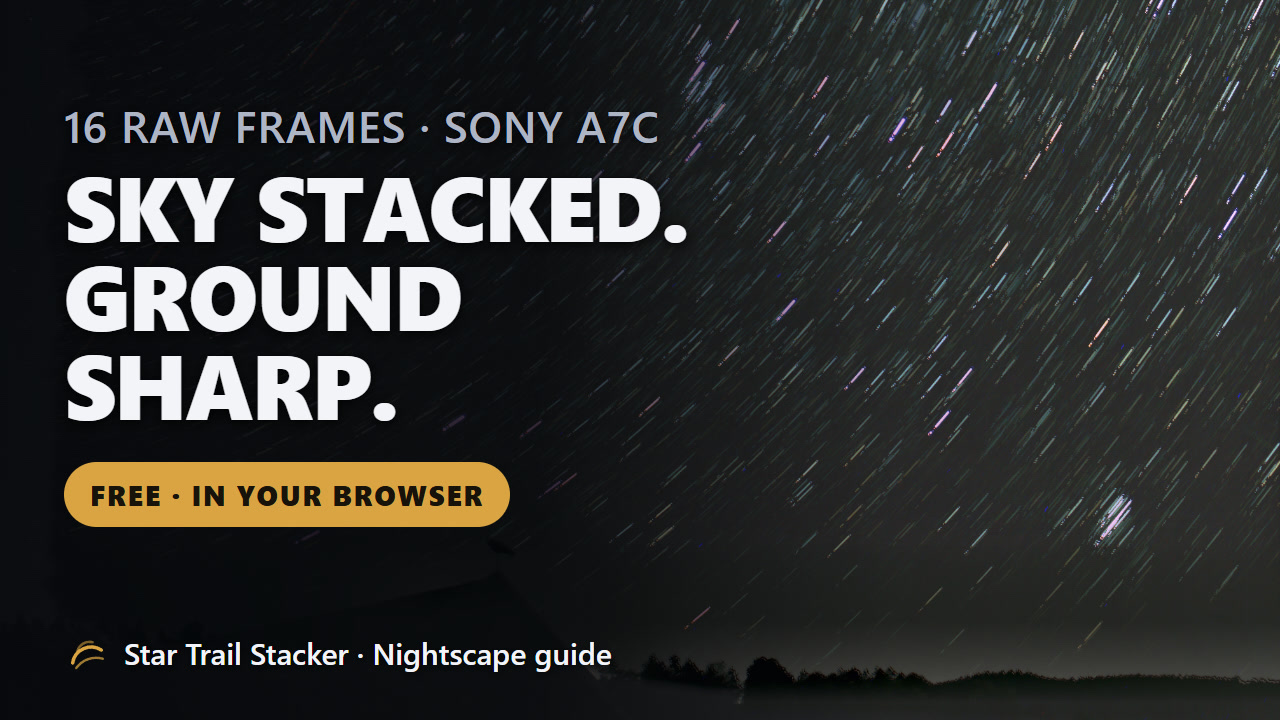
Cover for the Nightscape video guide 4:47 Video guide · 4:47 · YouTube, privacy-enhanced player The sky stacked, the ground kept sharp Sixteen Sony A7C Lights and ten darks, the sky region drawn three ways, a memory refusal at 8.1 GB against this browser’s 3.0 GB and the one working size that fits, then fourteen frames stacked and the two it set aside, named. Play →
13 chapters
  1. What it does
  2. Two subjects, one boundary
  3. The Lights
  4. The darks
  5. The recipe
  6. Resource plan
  7. The memory ceiling
  8. The run
  9. Done: fourteen of sixteen
  10. What moved on the ground
  11. The export at 100%
  12. Three files
  13. Wrap-up

Written guide: Fixed-ground nightscapes.

Calibration Lab

Cover for the Calibration Lab video guide 3:59 Video guide · 3:59 · YouTube, privacy-enhanced player Thirty-six darks, three nights, one honest master It sorts them by sensor, size and gain without being asked, builds two masters, refuses the five-frame group because robust clipping cannot honestly reject an outlier below eight, exports none of them unasked, and writes the sensor temperature as unverified rather than inventing it. Play →
10 chapters
  1. What a master dark is for
  2. Why a master
  3. One Light
  4. Thirty-six darks, three groups
  5. The recipe
  6. Built two, refused one
  7. Unverified, not invented
  8. One group, one master
  9. The FITS at 400%
  10. The master in use

Written guide: Calibration masters.

Deep sky

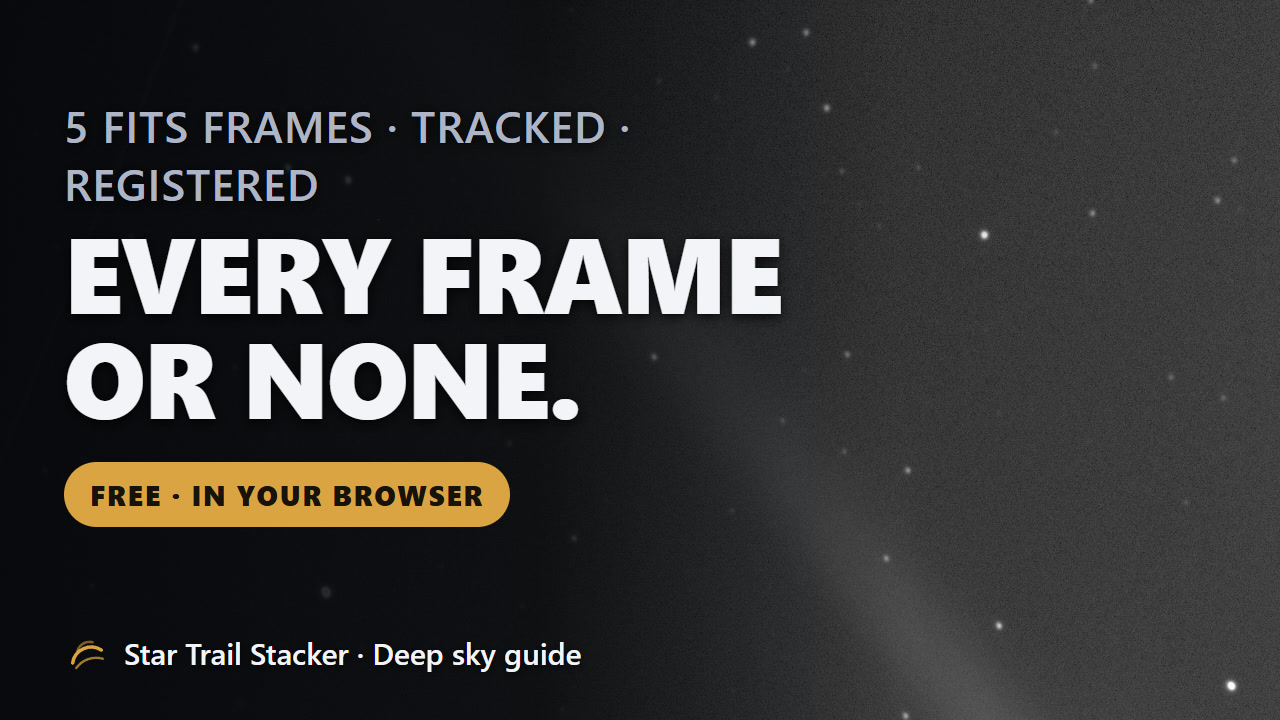
Cover for the Deep sky video guide 3:51 Video guide · 3:51 · YouTube, privacy-enhanced player It registers every frame, or it stops and says so First the night this mode should not be given — thirty tripod frames over a roof, whose receipt is honest about what ran and still cannot tell you the picture is wrong — then five calibrated FITS frames, where a sigma-clipped mean is refused at admission for having only five Lights. Play →
10 chapters
  1. What it does
  2. The mode that moves frames
  3. The wrong night
  4. Calibrated FITS, confirmed
  5. The recipe, and the eight-frame refusal
  6. The run
  7. The receipt
  8. At 100%
  9. Two files
  10. Wrap-up

Written guide: Registered deep-sky integration.

Planetary

Cover for the Planetary video guide 3:54 Video guide · 3:54 · YouTube, privacy-enhanced player Twenty lunar frames ranked, the best of them stacked The automatic target finder refuses the lunar limb because it is not a disc and says so; the rectangle is typed by hand; twenty frames are ranked in nineteen seconds; and the quality ledger shows every score with the measure it used. Play →
13 chapters
  1. What it does
  2. Lucky imaging
  3. One SER file
  4. The recipe
  5. Resource plan
  6. Not a disc
  7. Type the rectangle
  8. Ranked and stacked
  9. The ledger
  10. The footprint
  11. Two variants at 300%
  12. Four files
  13. Wrap-up

Written guide: Planetary SER lucky stacking.

Comet

Cover for the Comet video guide 4:07 Video guide · 4:07 · YouTube, privacy-enhanced player The stars sharp, the comet sharp, and a composite of both Five calibrated FITS frames of comet Nishimura. The nucleus is marked by hand on every Light because a missing point is never detected, interpolated or copied from a neighbour, and the receipt names the shared reference and every measured warp. Play →
11 chapters
  1. What it does
  2. A target that moves
  3. Calibrated FITS, confirmed
  4. Two arms, one aperture
  5. Prepare
  6. Mark every nucleus
  7. Stack
  8. The receipt
  9. Three results at 100%
  10. Six files
  11. Wrap-up

Written guide: Comet stacking.

The film and the covers

Cover for the The film and the covers video guide 4:21 Video guide · 4:21 · YouTube, privacy-enhanced player Two films and four covers, out of the same run The films are cut to the frame a platform wants, and the covers are made from the run’s own figures. The run states which limit bound the film — here memory, not the night — and a sixty-frame run shows the other case, where the night itself is shorter than the length asked for. Play →
13 chapters
  1. What else comes out
  2. The same night
  3. What the film shows
  4. The frame
  5. Length
  6. The run
  7. What bound: memory
  8. The files
  9. Two films
  10. What bound: the night
  11. The covers
  12. One to one
  13. Wrap-up

Written guide: Your first star trail.

Whose frames these are

The Nightscape, Calibration Lab and star-trail videos use nights shot on our own Sony A7C. The Planetary video uses a lunar SER capture from the PlanetarySystemStacker sample set (GPL-3.0). The Deep sky and Comet videos use luminance frames of comet C/2023 P1 Nishimura from the Moana Project’s open archive (CC BY 4.0), calibrated by us with the archive’s own masters before recording. Each video’s description credits its source.