Bringing out faint structure without inventing any
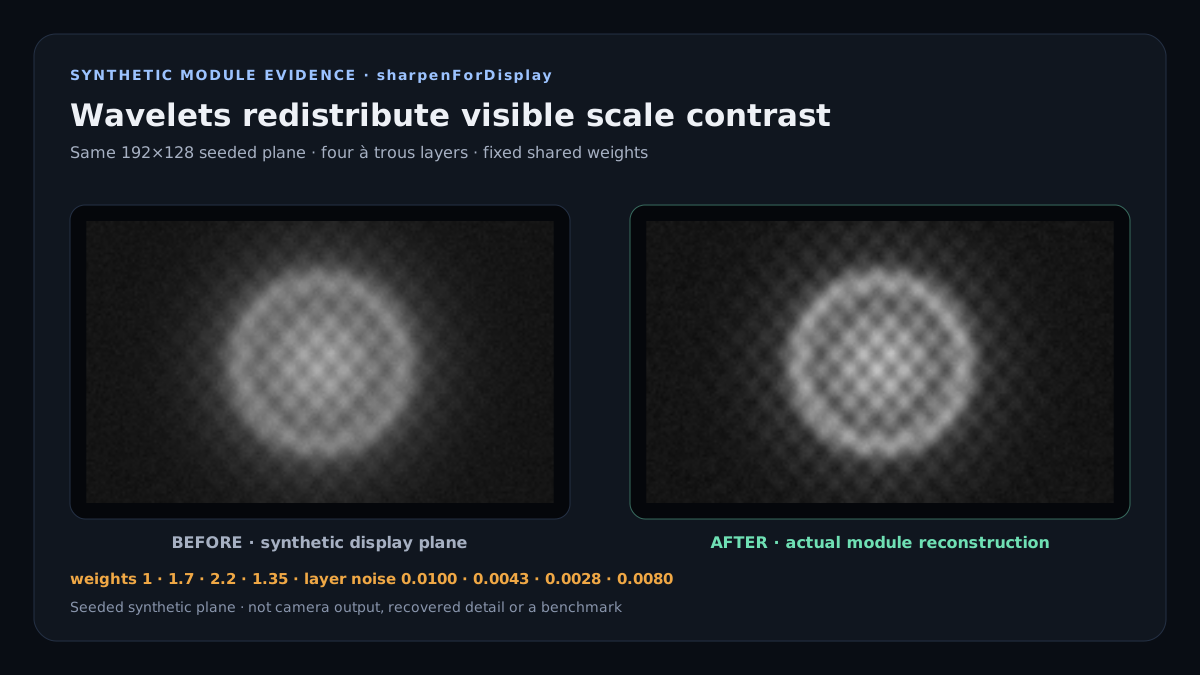
A stacked picture holds structure at every size at once, and a sharpening filter that treats them alike lifts the noise as eagerly as the detail; separating the picture by scale first means the sizes you care about can be lifted and the size that is mostly noise can be left alone.
On this page
The same frame, twice
This is one exposure of NGC 2392 from the ESO archive, through this tool. Nothing was retouched and nothing was painted in: the second panel is the first one with the middle scales weighted up and the finest left almost alone.
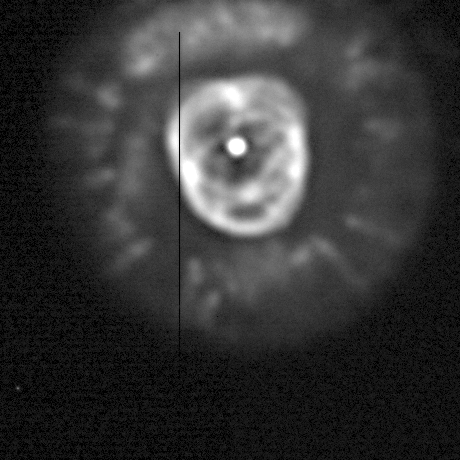
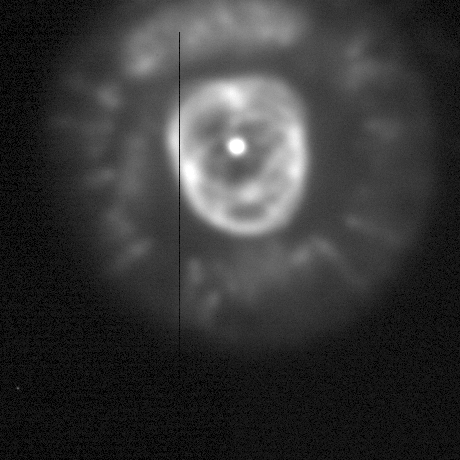
Drag, or use the arrow keys. The dark vertical line is a defective column in the detector and is in both panels — it is in the data, so it is in the picture. Frames from the ESO Science Archive under CC BY 4.0. Based on observations collected at the European Southern Observatory under ESO programme 60.A-9501(B).
Why the finest scale is left alone
The transform separates the picture into layers, each holding structure about twice the size of the one before, and it measures how much noise each layer is carrying. On this frame the finest layer measures 11.59 in the picture's own units and the three layers above it measure 3.07, 2.02 and 3.60.
That is the whole argument in four numbers. Layer one is mostly noise, so lifting it three times lifts the noise three times and calls the result sharpening. The layers above it are where the shell and the knots live. So the presets weight the middle and leave the first at or near one — and every one of them shows the weights it is sending, because a strength named “moderate” tells you nothing you can check.
Measured on this frame, the weighting raised the middle scales against the finest by a factor of 2.29. That is the number the picture above is worth.
The file you measure from never changes
Weighting scales is an interpretation — a decision about how much of each size you meant to see — so it reaches the PNG and the preview and stops there. The Float32 FITS holds the samples the stack produced, whatever the display was set to, and the browser check that drives this tool confirms the two files are byte-identical across a run with sharpening on and a run with it off.
The same rule covers the deconvolution beside it, which estimates what the sky looked like before the atmosphere spread it, using a point spread function measured from the frame's own stars rather than typed in — and refuses outright when there are fewer than twelve isolated stars to measure one from.
What the transform is, and the claim it does not make
The à trous or starlet transform: convolve the picture with a B3-spline kernel, subtract to get the finest detail, convolve again with the same kernel whose taps are spaced twice as far apart, and repeat. Nothing is decimated, so every layer is the full frame — which is why the tool refuses a decomposition that would not fit in memory, and refuses a scale whose kernel reaches past the edge of the picture.
With every weight at one the reconstruction is the input exactly. That property is worth less than it looks: the sum telescopes for any smoothing operator at all, so it would still hold with a kernel that does not sum to one and with the wrong spacing between scales. What actually pins those is elsewhere — a flat field staying flat, and a feature moving exactly one layer for every doubling of its size.
And what this cannot do: it adds no information. It recovers the contrast the eye loses when structure of several sizes is displayed at one stretch. A picture that had no shell in it does not grow one.
Try it on your own capture
Open the stacker Planetary mode carries the control, and the finished run reports the weights it used and the measured noise of every layer.