Does drizzle help your night, or just make a bigger file
Drizzle recovers detail finer than one pixel only when the frames landed on different parts of the pixel, and on a sequence that did not it produces an image twice the size holding exactly the same information; this measures which of those your night is and says so either way.
On this page
Where your frames landed inside the pixel
Each square below is one pixel, drawn large. Each mark is where one frame's sampling grid fell inside it — what is left after the whole pixels are taken away. That leftover is the entire question: a set spread across the square samples the sky in several places, and a set clustered in one corner samples it in one.
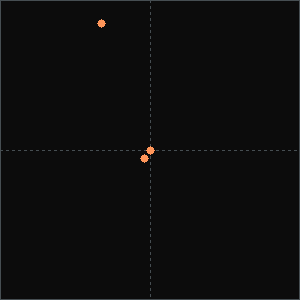
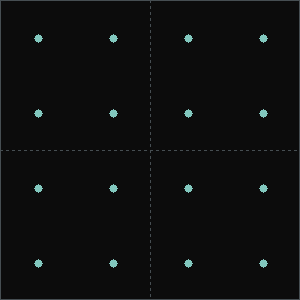
The left panel is measured from three B-filter EFOSC frames of NGC 2392, ESO Science Archive under CC BY 4.0. Based on observations collected at the European Southern Observatory under ESO programme 60.A-9501(B). The right panel is synthetic and exists to give the left one something to be compared against.
That sequence was dithered, and it was still refused
This is the case worth understanding, because it is the one a checkbox gets wrong. The telescope moved between exposures — genuinely, by several pixels — and the leftover phases are spread. And the answer is still no, for a reason that has nothing to do with dithering: three frames cannot fill a grid with four times as many cells in it. Most of the finer grid would have no light dropped on it at all.
So the refusal names the count, not the spread. A different night with the same dither and twenty frames would be accepted. That distinction is only available to a tool that measures both.
What the measurement actually is
A perfectly dithered set is spread uniformly over the pixel, and the standard deviation of a uniform spread over a unit interval is 0.289. That is the yardstick — not a number chosen to be reassuring. The worse of the two axes decides, because a set dithered across and not down would come out sharper across than down, which is not what drizzle promises.
Whole pixels are not dither. A set of frames at −3.5, 0.5 and 4.5 pixels is spread over eight pixels and lands on exactly one phase; only the fractional part counts, and the arithmetic here throws the whole pixels away before it measures anything.
What drizzle does, and what an empty output cell means
Fruchter and Hook, 2002, written for the Hubble Deep Field. Instead of interpolating each frame onto a finer grid, shrink every input pixel towards its own centre and drop it, splitting its light between the output cells it lands on by area. Over many frames whose sub-pixel positions differ, the output recovers detail finer than one input pixel — because each frame sampled the scene at a different phase.
It is taken from the recorded samples, never from the aligned frame: a resampled frame has already been forced onto one grid and has lost the very difference drizzle exists to exploit. That is also why this product could not have offered drizzle honestly until its registration measured sub-pixel positions at all — before that, every frame arrived in the same phase by construction.
Where few frames or a small drop size leave an output cell that no drop ever reached, the count is reported rather than the cell being written as zero. Black speckle presented as data is worse than a picture that says how much of it was filled in from a neighbour.
Ask it about your own night
Open the stacker Planetary mode carries the control, and the finished run says whether drizzle would have helped, with the number.
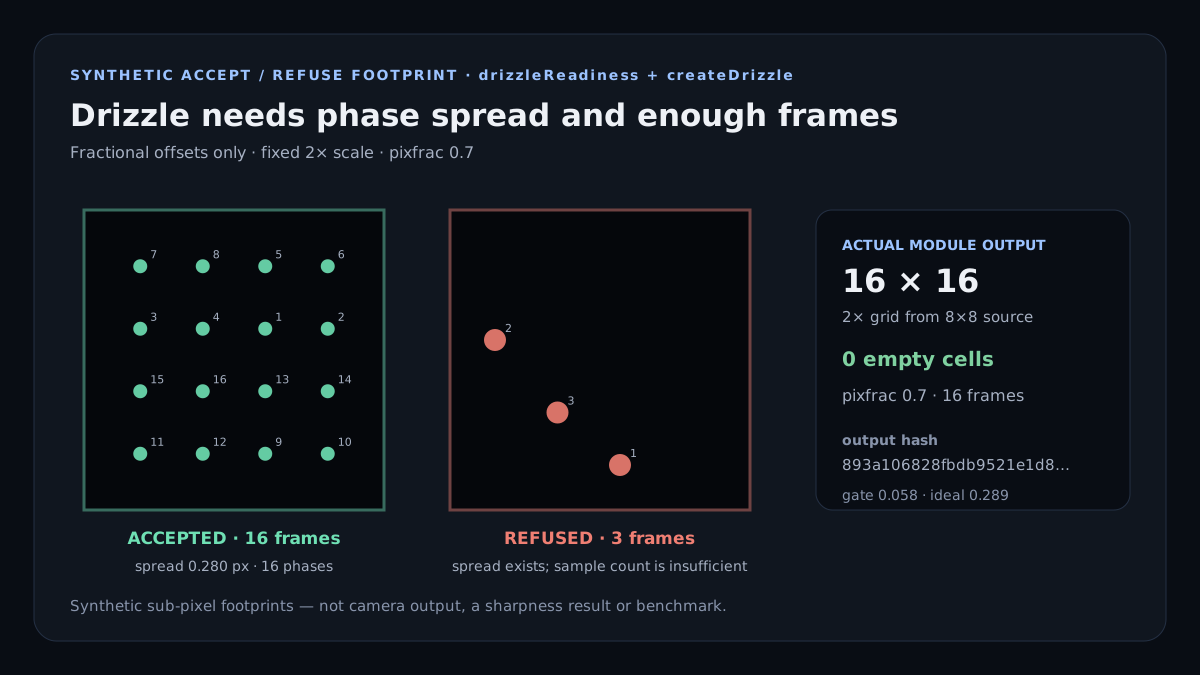
drizzleReadiness and createDrizzle evidence for accepted and refused inputs. It is not camera output, a sharpness result or benchmark.