The 500 rule, and why your sensor already broke it
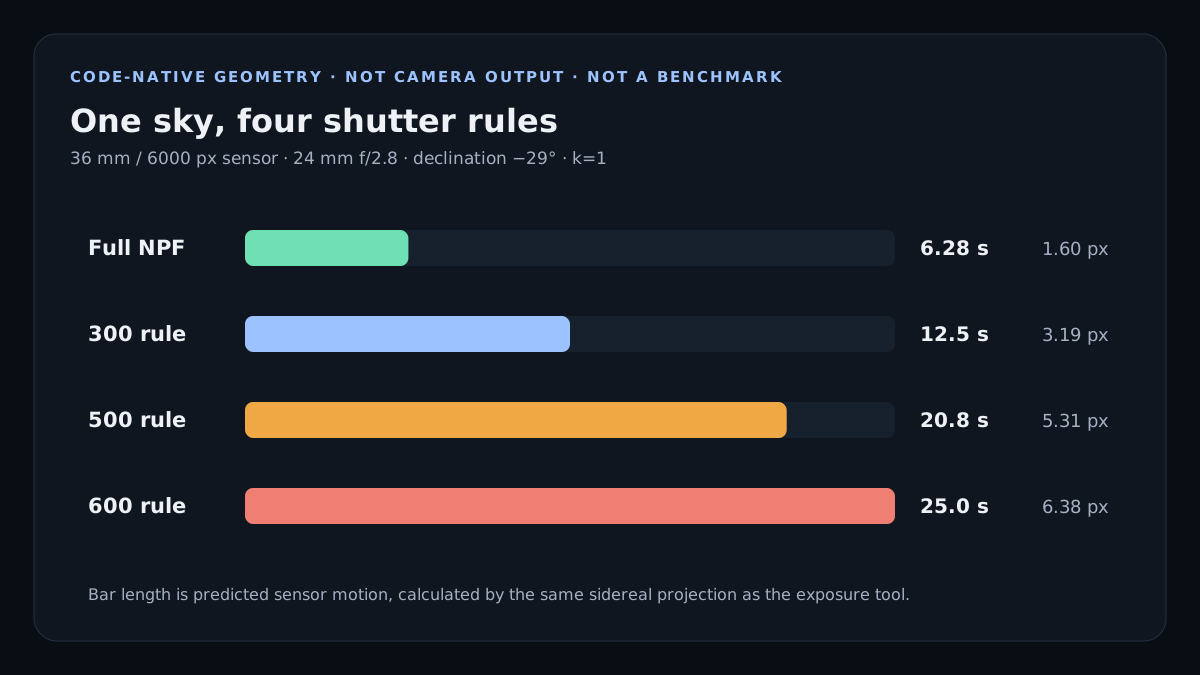
The 500 rule gives the longest un-trailed exposure as 500 divided by focal length, but a dense modern sensor trails sooner (closer to 300, or the NPF rule), stars near the celestial pole move far slower than those on the equator, and for star trails you want the trailing the rule exists to prevent. Here is what star motion is actually doing, so you can pick an exposure on purpose.
On this page
What the rule says, and where it came from
Divide 500 by your lens’s focal length and you get the longest exposure, in seconds, that keeps stars looking like points. A 20 mm lens gives 25 seconds; a 50 mm gives 10. The number 500 is not physics, it is a tolerance: it bakes in an assumption about how big a star can smear on the film before your eye calls it a streak. That assumption was set in the film era, for prints of a certain size.
Why a modern sensor broke it
Trailing is measured in pixels, not millimetres of film. A 24- or 45-megapixel sensor has far smaller pixels than a frame of film had grain, so the same real star motion covers many more pixels — and a streak two or three pixels long is already visible at 100%. On a dense sensor the honest number is closer to the 300 rule, and photographers who pixel-peep use the NPF rule instead, which actually folds in your aperture, pixel pitch and the declination of the field rather than a single constant. If your stars look soft at “500-rule” exposures, this is why.
Why where you point matters
Stars do not all move at the same speed across your frame. They wheel around the celestial pole, so a star near the pole — near Polaris in the north — barely moves, while a star on the celestial equator sweeps the full rate. The apparent speed scales with the cosine of the star’s declination: shoot straight up at the pole and you can expose far longer than the rule allows; frame the equator or the eastern horizon and the same exposure trails. The 500 rule pretends this does not happen. The NPF rule includes it.
For star trails, you want the opposite
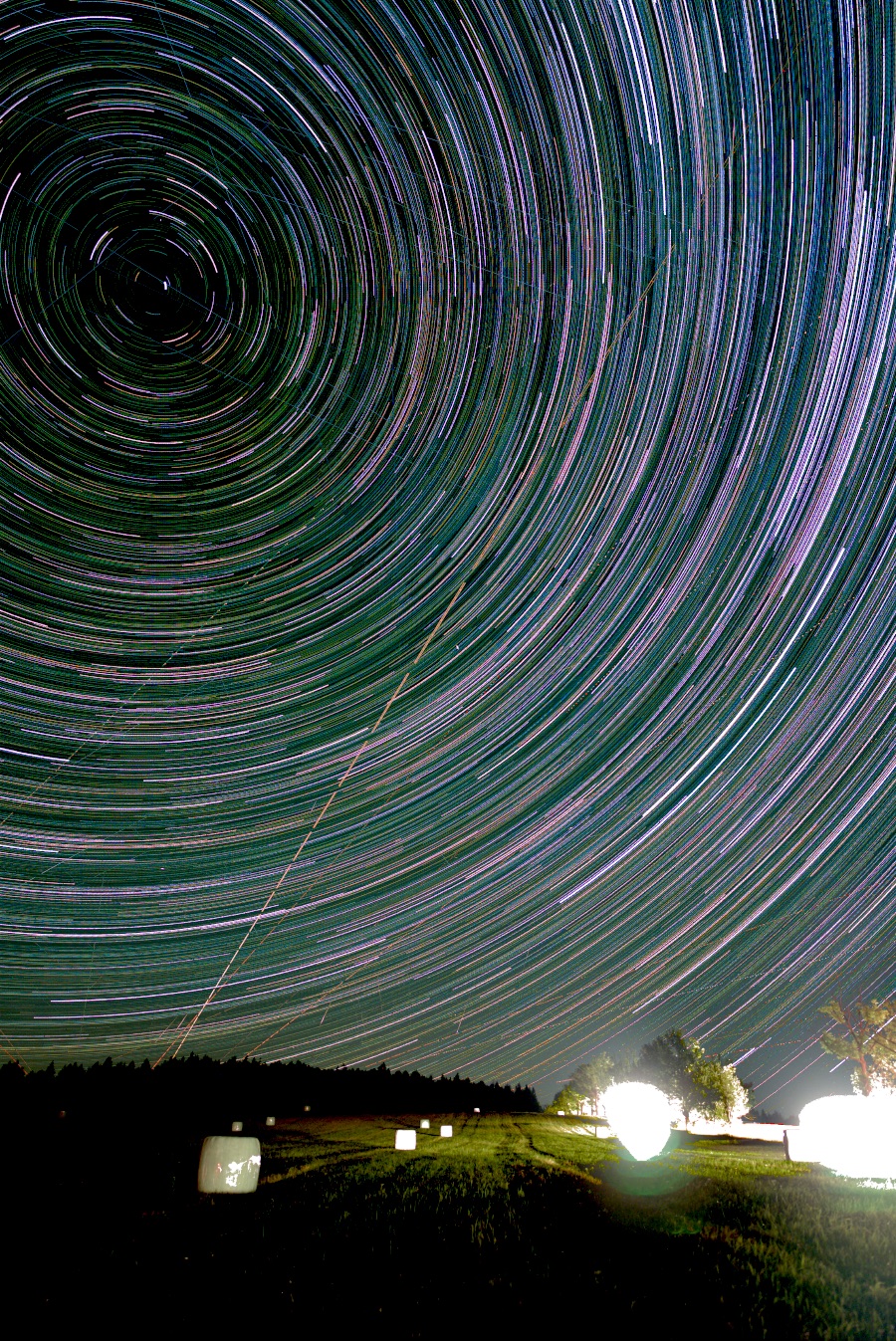
All of that is about avoiding trails. If you are here, you probably want them. The move is not one very long exposure — that buries your shadows in sky glow and hot-pixel noise, and one aircraft ruins the whole frame. Instead you shoot a long series of shorter exposures, each one comfortably within your sensor’s limit, and stack them: the trails join up, the noise averages down, the sky glow can be equalised away frame by frame, and a satellite that crosses one frame can be removed without touching the rest. The star motion the 500 rule fears is the whole picture you are building.
Plan the complete trail, not just one exposure
The 500 rule answers how long one frame can be. A trail needs the other half: how many frames fit in the night, how far the sky turns, and how much of every arc the shutter misses.
Calculating the sequence…
So how long should each frame be?
A worked table — 500, 600, 400 and NPF at six focal lengths on three sensor sizes — is on the calibration frames guide; the argument is here.
For trails, pick the longest exposure that still keeps each single frame clean at your ISO — often 20 to 30 seconds — and take as many as your battery and card allow, back to back, with the shortest gap your camera permits. The gap between frames is what leaves dashes in the trail; a short interval keeps them tight, and the tool fills what is left from the sequence’s own timing. More frames means longer arcs and a cleaner result, not a riskier single shot.
Compare NPF, 300 and 500-rule times for your own sensor, lens and field →